


The Life and Ministry of Christ, Part 46
Passion Week – Tuesday
After Jesus spoke words of condemnation over the religious leaders, Jesus was headed to the Mount of Olives. Before leaving the Temple area, He observed the manner in which people were making their contributions.
Mark 12:41 NKJV Now Jesus sat opposite the treasury and saw how the people put money into the treasury. And many who were rich put in much.
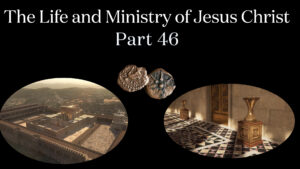
The treasury was inside the Women’s court in the Temple compound. It consisted of thirteen trumpet shaped boxes that were positioned around the court’s colonnade. The treasury was where worshippers contributed tithes and offerings. These brazen chests were called trumpets because of the appearance of their openings. Each of the thirteen money chests had a specific purposes. Nine chests were for temple tax, sacrifice-tribute, and gifts of money in place of sacrifices and the remaining four were for voluntary donations. The first two boxes collected the annual half-shekel temple tax. The third received the monetary equivalent from women bringing turtledoves for burnt sin offerings. Other boxes were for wood, incense, and golden vessels for the temple ministry. The remaining boxes collected surplus funds from trespass offerings, bird offerings, Nazarite vows, cleansed lepers’ offerings, and voluntary gifts. The women’s court was chosen so that everyone would have access to make their contributions.
Mark 12:42 NKJV Then one poor widow came and threw in two mites, which make a quadrans.
A mite was a small copper coin. A mite was worth less than a fourth of a penny. A quadrans was a copper Roman coin that had a value of 3/8 a penny.
Mark 12:43–44 NKJV So He called His disciples to Himself and said to them, “Assuredly, I say to you that this poor widow has put in more than all those who have given to the treasury; for they all put in out of their abundance, but she out of her poverty put in all that she had, her whole livelihood.”
This poor widow out of her poverty gave everything she had. By giving sacrificially, she completely entrusted herself to God to provide her needs. Nothing is said about what she was contributing to, but it appears to be some voluntary donation. The one thing Jesus noticed was that she held nothing back and gave all that she had. By commending the manner of her giving, Jesus turned the normal valuation of people upside down.
Matthew 6:3–4 NKJV But when you do a charitable deed, do not let your left hand know what your right hand is doing, that your charitable deed may be in secret; and your Father who sees in secret will Himself reward you openly.
The Apostle Paul gave instructions on how we should give.
2 Corinthians 9:6–7 NKJV But this I say: He who sows sparingly will also reap sparingly, and he who sows bountifully will also reap bountifully. So let each one give as he purposes in his heart, not grudgingly or of necessity; for God loves a cheerful giver.
Jesus was still in the Temple when a group of Greeks came to see Him.
John 12:20–22 NKJV Now there were certain Greeks among those who came up to worship at the feast. Then they came to Philip, who was from Bethsaida of Galilee, and asked him, saying, “Sir, we wish to see Jesus.” Philip came and told Andrew, and in turn Andrew and Philip told Jesus.
The mention of Greeks is quite significant for it introduces the Lord’s influence and ministry to the Gentiles. By attending the feast in Jerusalem to worship, they demonstrated their acceptance of the Jewish faith. They were present for the upcoming feast of Passover. As soon as they came, Jesus indicated a decisive hour had come and that it was now time for Him to die and be raised from the dead. What Jesus said was addressed to these Greeks and to His disciples.
John 12:23 NKJV But Jesus answered them, saying, “The hour has come that the Son of Man should be glorified.”
Prior to this, the Lord told them that His hour had not yet come. Now, the hour came for Him to be glorified. “Glorified” refers to His death and resurrection.
John 12:24 NKJV Most assuredly, I say to you, unless a grain of wheat falls into the ground and dies, it remains alone; but if it dies, it produces much grain.
He was primarily referring to His own death, burial and ultimate resurrection. This short parable illustrates the abundant fruit and glory that will result from His sacrifice and victory. The Lord’s death, burial, and resurrection make it possible for the birth and new life of everyone who believes in Him.
John 12:25–26 NKJV He who loves his life will lose it, and he who hates his life in this world will keep it for eternal life. If anyone serves Me, let him follow Me; and where I am, there My servant will be also. If anyone serves Me, him My Father will honor.
These verses refer to both Jesus and all who hear these words and this present life with its temporary pleasures and eternal life. By saying this, Jesus placed more emphasis and value on spiritual values rather than focusing on things that will soon fade away and lose value. Everyone must develop personal priorities in life that properly value their soul’s welfare. We cannot love the world and the things of the world and truly love and serve Him. If we genuinely love ourselves, we will willingly sacrifice our lives to follow Him. Jesus said, “If anyone serves Me, let him follow Me.” There is a specific reward for serving the Lord. Jesus said, “My Father will honor them.” After saying this, Jesus turned His focus toward the cross and His imminent sufferings and death.
John 12:27 NKJV “Now My soul is troubled, and what shall I say? ‘Father, save Me from this hour’? But for this purpose I came to this hour.”
When Jesus started this journey to Jerusalem, He announced that He was going to be betrayed, condemned, and delivered to be mocked, scourged, spit upon, killed and that He would arise the third day, (Matthew 20:17-19; Mark 10:32-34; Luke 18:31-34). Now before He went to the Garden of Gethsemane, Jesus was feeling the distress and agony of the cross. This is a revelation of the humanity of Christ and the struggle that the Lord faced walking in obedience to the Father. “My soul is troubled” indicated the acute emotional, mental, and spiritual distress He was entering into. He was determined to follow God’s eternal will and plan, even though it required His suffering and death.
John 12:28–29 NKJV “Father, glorify Your name.” Then a voice came from heaven, saying, “I have both glorified it and will glorify it again.” Therefore the people who stood by and heard it said that it had thundered. Others said, “An angel has spoken to Him.”
By saying — “Father, glorify Your name,” Jesus was offering Himself fully to the Father. After He said this, everyone heard a voice from the Father in heaven that was so clear and loud that they said it had thundered. The Father said, “I have both glorified it and will glorify it again.” Jesus glorified the Father’s name by fully offering Himself to completing the work assigned Him. Throughout His life and ministry, He had declared the Father’s name and He demonstrated the glory and work of the Father. Jesus had made personal and real the Father’s presence to the world. Now, He was giving Himself fully to complete the mission that the Father had sent Him to accomplish. This moment was a turning point in His life and ministry, where He explicitly declared what was about to unfold.
John 12:30–32 NKJV Jesus answered and said, “This voice did not come because of Me, but for your sake. Now is the judgment of this world; now the ruler of this world will be cast out. And I, if I am lifted up from the earth, will draw all peoples to Myself.”
Jesus did not need encouragement to persevere in doing the Father’s will. This voice from heaven was for their sake. Why did they need to hear “this voice?” Jesus was prophesying about the action that was being taken that would destroy Satan and his kingdom. Satan’s power, the power of his kingdom and sin is about to be broken. “Now” refers to the immediate action that Jesus was about to take on the cross.
John 12:32–33 NKJV “And I, if I am lifted up from the earth, will draw all peoples to Myself.” This He said, signifying by what death He would die.
John 3:14 NKJV And as Moses lifted up the serpent in the wilderness, even so must the Son of Man be lifted up.
John 12:34 NIV84 The crowd spoke up, “We have heard from the Law that the Christ will remain forever, so how can you say, ‘The Son of Man must be lifted up’? Who is this ‘Son of Man’?”
The prophets spoke of the eternal reign of the Christ, (Isaiah 9:7; Ezekiel 37:25; Psalm 72:17; Psalm 89:35-37).
Isaiah 9:7 NIV84 Of the increase of his government and peace there will be no end. He will reign on David’s throne and over his kingdom, establishing and upholding it with justice and righteousness from that time on and forever. The zeal of the Lord Almighty will accomplish this.
They all understood that the Son of Man was God’s promised Messiah, but they missed the fact of the suffering Savior that must be lifted up, or crucified. Their question demanded to know what kind of Messiah would die on the cross.
John 12:35–36 NKJV Then Jesus said to them, “A little while longer the light is with you. Walk while you have the light, lest darkness overtake you; he who walks in darkness does not know where he is going. While you have the light, believe in the light, that you may become sons of light.” These things Jesus spoke, and departed, and was hidden from them.
Throughout the Gospel of John, we are shown how the people did not believe even that Jesus did miraculous signs.
John 12:37–38 NKJV But although He had done so many signs before them, they did not believe in Him, that the word of Isaiah the prophet might be fulfilled, which he spoke: “Lord, who has believed our report? And to whom has the arm of the Lord been revealed?”
The LORD did sufficient miracles and signs before the people that they should have been convinced that He was the Messiah, the Son of God. There are consequences for not believing what God revealed. They could quote the prophets about the eternal nature of the Christ and were unable to see the prophecies about His suffering. The same Isaiah who spoke about the eternal nature of His reign also spoke about His sufferings. How could they fail to recognize the salvation and hope that Jesus Christ would provide?
John 12:39–41 NKJV Therefore they could not believe, because Isaiah said again: “He has blinded their eyes and hardened their hearts, Lest they should see with their eyes, Lest they should understand with their hearts and turn, So that I should heal them.” These things Isaiah said when he saw His glory and spoke of Him.
Why would God blind their eyes and harden their hearts? Sin and unbelief has that impact. Watch the impact.
John 12:42–43 NKJV Nevertheless even among the rulers many believed in Him, but because of the Pharisees they did not confess Him, lest they should be put out of the synagogue; for they loved the praise of men more than the praise of God.
Joseph of Arimathea and Nicodemus believed in Jesus but refused to confess Him openly for fear of the Pharisees. These religious leaders were not willing to pay the price even though they witnessed Jesus’ miracles. This passage questions the authenticity of their faith.
John 12:44–46 NKJV Then Jesus cried out and said, “He who believes in Me, believes not in Me but in Him who sent Me. And he who sees Me sees Him who sent Me. I have come as a light into the world, that whoever believes in Me should not abide in darkness.
John 12:47–48 NKJV And if anyone hears My words and does not believe, I do not judge him; for I did not come to judge the world but to save the world. He who rejects Me, and does not receive My words, has that which judges him—the word that I have spoken will judge him in the last day.
John 12:49–50 NKJV For I have not spoken on My own authority; but the Father who sent Me gave Me a command, what I should say and what I should speak. And I know that His command is everlasting life. Therefore, whatever I speak, just as the Father has told Me, so I speak.”
If anyone rejects the word and works of Christ, they are rejecting the Father who gave Him command. The result of that rejection is the loss of everlasting life.
How can we apply what the poor widow did to our giving? Is sacrificial giving necessary?
Can a person be a closet Christian?
How could they observe everything that Jesus said and did and not believe?
Living and ministering before them they witnessed the humanity of the Christ. How could one be despised and and appear weak enough to be crucified and be the Messiah?
Why does God harden a person’s heart?