

The Life and Ministry of Christ, Part 30
After leaving the temple, Luke 10 shows Jesus at the house of Mary and Martha. Mary and Martha’s house in Bethany was about 1.5 miles on the south-eastern slope of the Mount of Olives. Jesus had just revealed Himself as the Light of the world, now He goes back to Jerusalem and heals a man who was born blind. Isaiah prophesied about the Messiah opening the eyes of the blind. In Isaiah 42:7, the Messiah would be given as a covenant to the people, a light to the Gentiles to open blind eyes. Isaiah 29:18 …the deaf shall hear and the blind shall see. Isaiah 35:5 …the eyes of the blind shall be opened, and the ears of the deaf shall be unstopped. Although Jesus healed the blind throughout His ministry, this is the only mention of one born blind being healed.
Man Born Blind Healed – John 9:1-41
John 9:1-2 NKJV Now as Jesus passed by, He saw a man who was blind from birth. And His disciples asked Him, saying, “Rabbi, who sinned, this man or his parents, that he was born blind?”
There was a widespread theological assumption that accepted a retribution principle. The retribution principle is a belief that suffering is a direct result of sin. It assumes that prosperity is an indication of righteousness and affliction is a sign of wickedness. If one was sick or suffers, the presumption is that it is a punishment for sin. Jesus countered this assumption by explaining that the man’s blindness existed “that the works of God should be revealed in him,” (John 9:1-7). Many people have wondered why sickness, disease and death inflict the world.
Romans 5:12 NKJV Therefore, just as through one man sin entered the world, and death through sin, and thus death spread to all men, because all sinned.
Romans 3:23 NKJV For all have sinned and fall short of the glory of God.
Sickness, pain and death entered into the human race as a result Adam and Eve’s sin. The legalists argued that there must be personal sin for a person to be suffering. The disciples presented two of these assumptions to the Lord.
John 9:2 NKJV “Rabbi, who sinned, this man or his parents, that he was born blind?”
First, the baby sinned while in the womb.
Since the man was born blind, he must have sinned before birth. Deuteronomy 28:15-68, shows several blessings and curses that come as a result of obedience or personal sin.
Jeremiah 31:30 NKJV But every one shall die for his own iniquity; every man who eats the sour grapes, his teeth shall be set on edge.
Can a baby commit acts of sin while in the womb?
This deals with the deeper theological concepts about the nature of sin and moral agency. Some argue that Jacob grasping his brother’s heel in the womb was an evil act of unlawfully taking power over Esau. That pattern continued throughout his life. This perspective assumes that an infant’s soul has the capacity to exercise moral agency from the beginning. The opposing view contends that a baby cannot commit sin because “lawlessness” requires moral choice and people become sinners through disobedience to God’s law.
Psalms 51:5 AMP I was brought forth in a state of iniquity; my mother was sinful who conceived me [and I too am sinful].
The Psalmist was not saying that sin is transmitted biologically or that conception and birth are evil. He was saying I have committed sin and am sinful in nature.
Second, the parent’s sin resulted in the baby being in that condition.
Exodus 20:5; 34:7 and Numbers 14:18 says: “God by no means clears the guilty, visiting the iniquity of the fathers on the children to the third and fourth generation.”
Jeremiah 31:29 Fathers have eaten sour grapes. And the children’s teeth are set on edge.
Lamentations 5:7 “our fathers sinned… we bear their iniquities.”
Those who hold to this belief accept the concept of a generational curse. This is a curse that comes as a result of behavioral patterns inherited from one generation to another due to rebellion against God. The sins of the parents are visited upon the children to the third and fourth generation. The effects of sin naturally pass down because children typically practice the same sinful lifestyle as their parents. The generational curse can be broken by confession of one’s sin and repentance (turning from that lifestyle).
In this situation, Jesus rejected both ideas.
Jesus’ response does not deny universal sinfulness. No one else has to sin for evil, bad circumstances, sickness or disease to occur. When sin entered in Genesis 3, so did the curse. The curse brings every kind of evil and condition that we contend with. As difficult as it is for us to understand, sometimes we must confront our giants so that God’s glory and power may be known.
John 9:3–5 NKJV Jesus answered, “Neither this man nor his parents sinned, but that the works of God should be revealed in him. I must work the works of Him who sent Me while it is day; the night is coming when no one can work. As long as I am in the world, I am the light of the world.”
In this man’s case, neither personal sin nor the sin of the parents brought on his blindness. His sin was not brought on by some specific sin. Instead the problem existed so that God could display His glory.
Exodus 4:11 NKJV So the Lord said to him, “Who has made man’s mouth? Or who makes the mute, the deaf, the seeing, or the blind? Have not I, the Lord?
There are many Biblical examples when God turned what looked like disaster into something that brought Him glory. At the Red Sea crossing it looked like they would be destroyed by Pharaoh’s army. Peter was walking on the water until fear gripped him. Five thousand people were hungry until Jesus multiplied the loaves and fish. Lazarus’ sickness and death gave opportunity for the glory of God to be revealed. Some of the events of our lives have been turned around to bring glory to God.
John 9:6–7 NKJV When He had said these things, He spat on the ground and made clay with the saliva; and He anointed the eyes of the blind man with the clay. And He said to him, “Go, wash in the pool of Siloam” (which is translated, Sent). So he went and washed, and came back seeing.
Why did Jesus make clay to anoint the man’s eyes and tell him to “go, wash in the pool of Siloam?” There was not healing virtue in the clay. This was a exercise that caused the man to develop his faith. Elisha required Naaman the Syrian to dip seven times in the Jordan River, 2 Kings 5:10-13. In Mark 8:23, Jesus spat on the blind man’s eyes and put His hands on him. In Luke 6:10; Jesus told the man with a withered hand to stand in front of the crowd and stretch out his hand. All of these caused individuals to exercise faith.
The pool of Siloam was the termination point of a tunnel that Hezekiah had made to bring water into Jerusalem, (2 Kings 20:20; 2 Chronicles 32:30).
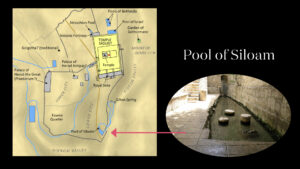
The tunnel was driven through the rock of the temple mount into the inner city. Water flows from Spring Gihon to the Pool of Siloam. Today the pool is 50 feet long and 5 feet wide and lies 16 steps below street level.
The result of the man’s obedience and his healing brings the conversation for the remainder of the chapter.
First, the man went and washed and came back seeing, John 9:7.
Everyone was amazed because he was born blind. This case was so distinctive because of the permanence associated with congenital blindness. Someone born blind has no memory of vision and could not fully grasp what he lacked. His condition and the radical change after being healed made it difficult for everyone to recognize him.
Second, the people began to argue, John 9:8-10.
They could not believe that he was the same man. They thought it was someone who looked like him. The man said: “I am he.”
Third, praise to Jesus, John 9:11.
John 9:10–11 NKJV Therefore they said to him, “How were your eyes opened?” He answered and said, “A Man called Jesus made clay and anointed my eyes and said to me, ‘Go to the pool of Siloam and wash.’ So I went and washed, and I received sight.”
As a result of the tumult that was caused in the community by this miracle, they brought the healed blind man to the Pharisees. The Pharisees were highly respected religious leaders and their opinion controlled much of their community affairs. Pharisees originated among the Hasidim (“pious ones”) and the Hasid (“holy ones”). The word Pharisee means “separate ones.” They took pride in their community positions. They valued the Torah – Law (first five books of the Bible) and were known for their oral traditions or interpretations of the Written Law. According to Jewish tradition, God taught the oral tradition to Moses who passed it to Joshua. From Joshua, the oral tradition was passed to the elders and prophets until it reached the rabbinical authorities. None of the oral traditions were written in the Old Testament. The codification of the oral traditions became the Mishnah around 200 C.E. They believed their oral traditions were the truth and were valued above the written Law. The Jews admired the Pharisees for their “piety.”
John 9:13-33 is a conversation between the Pharisees, the parents, people of the community, and the healed blind man.
The Pharisees said if anyone confessed Jesus was the Christ, they would be put out of the Synagogue. This added to the foundation for debate.
First, they asked the man about what happened.
He said, “He put clay on my eye, and I washed, and I see.” The Pharisees believed that since Jesus “violated” the Sabbath by making clay, He was a false prophet and could not be from God. According to their oral traditions, making clay was work and Jesus had worked on the Sabbath. As a result, they said, “Jesus was a sinner.” Some said, “how could a sinner do such signs? They asked the blind man, “What do you say about Him because He opened your eyes?” He said, “He is a prophet.”
Second, the Pharisees confronted his parents.
Is he your son? Was he born blind? How does he see? They were afraid of the Pharisees because they did not want to be put out of the Synagogue. The synagogue represented the people of the whole community. To be put out of the synagogue would mean a loss of business, prestige, and community fellowship. His parents said, “He is of age; ask him.”
John 9:24–25 NKJV So they again called the man who was blind, and said to him, “Give God the glory! We know that this Man is a sinner.” He answered and said, “Whether He is a sinner or not I do not know. One thing I know: that though I was blind, now I see.”
When they said, “Give God the glory,” they wanted the man to agree with them that both Jesus and the blind man were sinners. His reply infuriated them. “Whether He is a sinner or not I do not know. One thing I know: that though I was blind, now I see.”
John 9:26-27 NKJV Then they said to him again, “What did He do to you? How did He open your eyes?” He answered them, “I told you already, and you did not listen. Why do you want to hear it again? Do you also want to become His disciples?”
John 9:28-29 NKJV Then they reviled him and said, “You are His disciple, but we are Moses’ disciples. We know that God spoke to Moses; as for this fellow, we do not know where He is from.”
John 9:30 NKJV The man answered and said to them, “Why, this is a marvelous thing, that you do not know where He is from; yet He has opened my eyes!
The man that was healed continued to teach them since they claimed ignorance of Jesus’ origin.
John 9:31–32 NKJV Now we know that God does not hear sinners; but if anyone is a worshiper of God and does His will, He hears him. Since the world began it has been unheard of that anyone opened the eyes of one who was born blind.
He reasoned that God does not grant the request of sinners but the righteous and it had never been reported that one born blind received their sight.
John 9:33–34 NKJV If this Man were not from God, He could do nothing.” They answered and said to him, “You were completely born in sins, and are you teaching us?” And they cast him out.
Once again the Pharisees stated their belief that this man was completely born in sins, (Job 14:4; Psalms 58:3; Romans 5:12). The Pharisees reacted this way because Jesus’ actions were in contradiction to what they taught. Being cast out resulted in his excommunication from Jewish religion and community.
John 9:35–36 NKJV Jesus heard that they had cast him out; and when He had found him, He said to him, “Do you believe in the Son of God?” He answered and said, “Who is He, Lord, that I may believe in Him?”
Notice that the man did not know Who Jesus was and asked, “Who is He, that I may believe in Him?”
John 9:37–38 NKJV And Jesus said to him, “You have both seen Him and it is He who is talking with you.”Then he said, “Lord, I believe!” And he worshiped Him.