

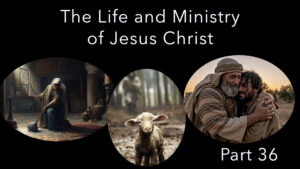
The Life and Ministry of Christ, Part 36
Jesus spoke about the wedding feast in the kingdom of God during a Sabbath meal at the home of the Pharisees. He said when those who were invited refused to come, the owner of the house sent servants to persuade beggars, outcast and the homeless to come in, so that my house will be full. Before we look into Luke 15, we should remember that Jesus had been rejected by the Pharisees, Scribes, and Lawyers. Not only had they rejected Him, they turned against Him and looked for opportunities to kill Him. As we have already noticed, the multitudes of people that came after Jesus were in desperate need of help. They were sick, oppressed, hungry and destitute. Now in Luke 15, the LORD gave three parables about recovering what is lost. The purpose for the parables is found in verses 1-3.
Luke 15:1–3 NKJV Then all the tax collectors and the sinners drew near to Him to hear Him. And the Pharisees and scribes complained, saying, “This Man receives sinners and eats with them.” So He spoke this parable to them, saying:
The Pharisees and teachers of the Law thought the tax collectors and sinners were hopeless and should be shunned and excluded. Since nothing could be done to help them, why would Jesus entertain and allow tax collectors and sinners to come near to Him? It was obvious that the people that drew near to Jesus were outwardly sinners. Jesus constantly reproved individuals of their sins and transgressions. Those who acknowledged Him as Lord and sincerely repented of their sins found help, healing, blessings, and forgiveness. Since the Pharisees and scribes felt that there was nothing that could be done to help those people, they resented the fact that Jesus received and helped them. They complained, “This Man receives sinners and eats with them.” By doing this, they felt that Jesus was unworthy and unclean since He associated with sinners. In reality, this was the very reason that Christ came into the world so that they might be saved. The three parables on recovering what was lost were spoken to the Pharisees and scribes who had rejected those who were sinners and lost.
Parable of the Lost Sheep – Luke 15:4-7; Matthew 18:12-14
In this parable, Jesus is represented as the Shepherd. Watch the value the Shepherd places the lost sheep.
Luke 15:4 NKJV What man of you, having a hundred sheep, if he loses one of them, does not leave the ninety-nine in the wilderness, and go after the one which is lost until he finds it?
When a shepherd realizes that one of his sheep is lost, what does he do? I have known many farmers and ranchers that were a living demonstration of this parable. They know their flocks and herds so well that they know when one is missing. When the shepherd realizes that one of them is lost, Jesus said he leaves the ninety-nine in the open field and goes into the wilderness to find the one that is lost. Jesus acknowledged before the Pharisees and scribes that there are people outside their groups. There are “lost sheep” in the wilderness. This parable is similar to the message Jesus gave in Matthew 18 where He said, “The Son of Man has come to save that which is lost.” In Matthew 18:14, He said, “It is not the will of your Father who is in heaven that one of these little ones should perish.”
Luke 15:5–6 NKJV And when he has found it, he lays it on his shoulders, rejoicing. And when he comes home, he calls together his friends and neighbors, saying to them, ‘Rejoice with me, for I have found my sheep which was lost!’
The Lord does not stop searching until He finds the lost sheep. His search includes every aspect of His coming to earth, His ministry, rejection, suffering, and death. His search required much sacrifice and effort to seek and to save the lost sheep. We cannot know the extent of self-sacrifice and suffering that the Lord passed through to rescue the lost.
Notice what the Shepherd does when He finds lost sheep.
First, He takes them upon His shoulders and takes them to His home. Have you personally noticed the LORD’S tender care when He found you in sin and took you in? Jesus said, “After he found and recovered the LOST sheep, he summoned his friends and neighbors and rejoiced over its salvation.” It is indeed an act of grace that the Shepherd of our souls searches for us when we are lost. Consider the phrase, “He lays it on his shoulders.” Have you realized the extent of Jesus Christ being your burden bearer? Not only does He address our need, He takes us up and carries our sin, sickness, and pain. Why does the Lord rejoice when the lost are found? You should know that the LORD has placed a high value on you and your soul.
Luke 15:7 NKJV I say to you that likewise there will be more joy in heaven over one sinner who repents than over ninety-nine just persons who need no repentance.
There is great joy in heaven in the presence of the Father over every sinner who repents. The word “repents” means to express sincere regret or remorse and to change one’s mind and way for a better course of life. Repentance is turning from one’s past sins to the LORD. There is more joy in heaven when one sinner repents than over 99 righteous persons who have no need of repentance. This does not mean that we all have not sinned, it is referring to the recovery of what was lost.
Parable of the Lost Coin – Luke 15:8-10
In the next parable, watch how the woman searches for the lost coin.
Luke 15:8 NKJV Or what woman, having ten silver coins, if she loses one coin, does not light a lamp, sweep the house, and search carefully until she finds it?
This message is essentially the same as the parable of the lost sheep, but it emphasizes the extensive detail of the search. Notice that she lights a lamp and carefully sweeps the house searching for the lost coin. When we lose something that was valuable, we will turn the house upside down searching for it.
Luke 15:9–10 NKJV And when she has found it, she calls her friends and neighbors together, saying, ‘Rejoice with me, for I have found the piece which I lost!’ Likewise, I say to you, there is joy in the presence of the angels of God over one sinner who repents.”
In both parables, Jesus said there is rejoicing in heaven when one sinner repents. It is amazing to see that there is rejoicing in the presence of the angels of God in heaven when the sinner repents. Think about the fact that all of heaven rejoices when one sinner repents. Consider that the focus of the angels in heaven is around the throne of God. Jesus Christ is seated at the right hand of the Father and the seraphim, cherubim, archangels, and angels occupy various designated positions. This rejoicing in the presence of the angels of God over one sinner who repents represents all of heaven being involved in the celebration.
Parable of the Prodigal Son – Luke 15:11-32
God the Father is depicted as the man with two sons. The Pharisees and scribes complained that Jesus both received and ate with tax collectors and sinners.
Luke 15:11–12 NKJV Then He said: “A certain man had two sons. And the younger of them said to his father, ‘Father, give me the portion of goods that falls to me.’ So he divided to them his livelihood.
It is very apparent that the younger son wanted his portion of his inheritance so that he could live independently of his father’s will. The father distributed to both of his sons their proper share ahead of time. We should not waste what God has given us.
Luke 15:13–14 NKJV And not many days after, the younger son gathered all together, journeyed to a far country, and there wasted his possessions with prodigal living. But when he had spent all, there arose a severe famine in that land, and he began to be in want.
Prodigal living is reckless extravagance and wasteful spending. Prodigal living is a lifestyle that is undisciplined, loose, and devoid of character. It is characterized as wine, women and song. It involves more than wasteful spending. It is the deliberate overindulgence of sensual pleasures. The prodigal wanted to distance himself from any restraining influences. This represents the sinner moving away from God. Sin will take you farther than you want to go, keep you longer than you want to stay, and cost you more than you want to pay. As soon as his inheritance was gone, a famine arose. The word “famine” represents the lack, ruin and depression that comes to every sinner. It happens when anyone wastes the inheritance that God gives. Notice how far the prodigal lifestyle took him and how much it cost.
Luke 15:15–16 NKJV Then he went and joined himself to a citizen of that country, and he sent him into his fields to feed swine. And he would gladly have filled his stomach with the pods that the swine ate, and no one gave him anything.
The only employment available was feeding swine. Jews considered working with swine to be very distasteful. According to the Law, pigs were among the unclean animals that should be avoided, (Leviticus 11:24-28). Anyone who touched an unclean animal became unclean. After he had wasted his inheritance, he was ready and willing to go into the pig pins. Before he left his father’s care, he would have never considered doing this. This happens to anyone that wastes God’s blessings and goes into prodigal living. It may start with a single act of disobedience or rebellion against God. If not repented of, sin always takes the rebellious into self-destructive actions and activities.
Luke 15:17 NKJV But when he came to himself, he said, ‘How many of my father’s hired servants have bread enough and to spare, and I perish with hunger!’
Luke 15:18–19 NKJV ‘I will arise and go to my father, and will say to him, “Father, I have sinned against heaven and before you, and I am no longer worthy to be called your son. Make me like one of your hired servants.” ’
How far down does a sinner have to go before they come to themselves? When he came to himself, he was ready to go home. What does “he came to himself” mean? Coming to one’s senses is a critical part of repentance and salvation. This is a function of the Holy Spirit’s work on the sinner. Before this awakening, the prodigal had been spiritually and psychologically lost. He was not just lost from God but also from himself. He lacked understanding and direction in life. This awakening was not just about his situation; it was a shift in focus, a turning back to God. The Holy Spirit is deeply involved in bringing people to the realization of their condition and need. The change that happened in that moment in the prodigal son was a complete change from the attitude he had when he left home.
Luke 15:20 NKJV And he arose and came to his father. But when he was still a great way off, his father saw him and had compassion, and ran and fell on his neck and kissed him.
This is a demonstration of the heavenly Father’s attitude toward the lost. The Father rejoices when a sinner comes home. “God is not willing that any should perish, but that all should come to repentance.” (2 Peter 3:9)
Luke 15:21 NKJV And the son said to him, ‘Father, I have sinned against heaven and in your sight, and am no longer worthy to be called your son.’
When the son left, he did not consider his rebellion to be sin. Now he who was privileged and blessed was willing to serve wherever his father desired. Watch the Father’s response to the return of his son.
Luke 15:22 NKJV But the father said to his servants, ‘Bring out the best robe and put it on him, and put a ring on his hand and sandals on his feet.
Luke 15:23–24 NKJV And bring the fatted calf here and kill it, and let us eat and be merry; for this my son was dead and is alive again; he was lost and is found.’ And they began to be merry.
This is a parallel statement to “there is joy in the presence of the angels of God over one sinner who repents.” (vs. 10) We should rejoice when the sinner comes home. The older son’s attitude is a reflection of how the Pharisees and Lawyers were responding to Jesus entertaining sinners.
Luke 15:25–26 NIV84 Meanwhile, the older son was in the field. When he came near the house, he heard music and dancing. So he called one of the servants and asked him what was going on.
Luke 15:27–28 NIV84 ‘Your brother has come,’ he replied, ‘and your father has killed the fattened calf because he has him back safe and sound.’ “The older brother became angry and refused to go in. So his father went out and pleaded with him.
Luke 15:29 NIV84 But he answered his father, ‘Look! All these years I’ve been slaving for you and never disobeyed your orders. Yet you never gave me even a young goat so I could celebrate with my friends.
Luke 15:30 NIV84 But when this son of yours who has squandered your property with prostitutes comes home, you kill the fattened calf for him!’
Luke 15:31–32 NIV84 “ ‘My son,’ the father said, ‘you are always with me, and everything I have is yours. But we had to celebrate and be glad, because this brother of yours was dead and is alive again; he was lost and is found.’ ”
The Pharisees and the teachers of the Law had the same attitude toward sinners as the older son had toward the younger son. They were angry with the message Jesus was proclaiming that anyone could be saved. Notice that the elder son thought he had a relationship with the father because of his works. He did not serve his father out of love but for the reward. He even felt that he was in bondage to his father. If the Pharisees and Lawyers would have realized their privileged position as “God’s Chosen People” and guardians of the covenants and Law, they would have rejoiced when others became part of the kingdom.
Why does God allow us to go into a lifestyle that is independent and against His will?
What was the Prodigal son’s confession? Luke 15:21
How does the older brother represent self-righteousness?
Why did he have trouble rejoicing over his prodigal brother?
Was it just and right for the father to do what he did with the prodigal son?
How does God react to repentant sinners?