

The Life and Ministry of Christ, Part 41
As Jesus progressed toward Jerusalem, He entered and passed through Jericho. This Jericho was built near the location where the walls fell before Joshua and the Israelites. There was a curse placed on anyone who rebuilt Jericho, but during the days of the wicked King Ahab, Jericho was rebuilt, (1 Kings 16:33-34). As Jesus passed through Jericho, the crowds were pressing in around Him.
Zacchaeus – Luke 19:1-10
Luke 19:2 NKJV Now behold, there was a man named Zacchaeus who was a chief tax collector, and he was rich.
Zacchaeus was a tax collector in Jericho who had become quite wealthy and well-known in the community. As the chief tax collector, he was in charge of other tax collectors who gathered taxes and he got a share of the money. Being on a major road going east and west, Jericho was a collection point for taxes on produce that was being transported to markets. Jews resented paying taxes to the Roman occupiers and as a result tax collectors we despised. There was a common belief that all tax collectors were dishonest and traitors to Rome.
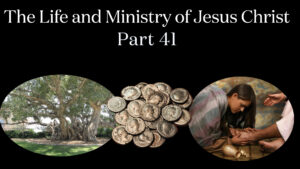
Luke 19:3–4 NKJV And he sought to see who Jesus was, but could not because of the crowd, for he was of short stature. So he ran ahead and climbed up into a sycamore tree to see Him, for He was going to pass that way.
Zacchaeus was curios about this Man who was being followed by such a large crowd, so he ran ahead and climbed up into a sycamore tree. Sycamore trees have many branches, making them good for climbing. Although he was curious, he knew nothing about Jesus and did not particularly want to have an encounter with Him. Remember that Jesus was constantly on a divine appointment from the Father. It is noteworthy that the blind man and Zacchaeus were part of the reason Jesus went through Jericho. Both of them were considered outside the normal Jewish system because of their positions and conditions. The LORD had just given the parable about how difficult it was for a wealthy person to be saved.
Luke 19:5 NKJV And when Jesus came to the place, He looked up and saw him, and said to him, “Zacchaeus, make haste and come down, for today I must stay at your house.”
Knowing his name and where he was is a strong indication that Jesus had a divine appointment. He called him by name and said, “Today, I must stay at your house.” This is the only time mentioned that Jesus invited Himself into someone’s house. Verses 9 and 10 show the reason for this encounter.
Luke 19:9–10 NKJV And Jesus said to him, “Today salvation has come to this house, because he also is a son of Abraham; for the Son of Man has come to seek and to save that which was lost.”
Although Zacchaeus was of the lineage of Abraham, he was a sinner. We should not overlook that last phrase: “for the Son of Man has come to seek and to save that which was lost.” This was Jesus’ mission to seek and save the lost.
Luke 19:6–7 NKJV So he made haste and came down, and received Him joyfully. But when they saw it, they all complained, saying, “He has gone to be a guest with a man who is a sinner.”
This joyful response means he gladly welcomed Jesus with rejoicing. Joy and gladness are customary responses when sinners have an encounter with Jesus. Notice how the crowd responded when Jesus turned His attention to an unworthy sinner. The crowd thought Zacchaeus was a bad investment in the Lord’s time. Jesus said, “the Son of Man has come to seek and to save that which is lost,” (verse 10). We would all be up a tree if the Lord did not come to save us. Notice the change that occurred when Zacchaeus received Jesus into his life.
Luke 19:8 NKJV Then Zacchaeus stood and said to the Lord, “Look, Lord, I give half of my goods to the poor; and if I have taken anything from anyone by false accusation, I restore fourfold.”
We should expect people to change when Jesus comes into their lives and saves their soul. Zacchaeus was not saved because he was willing to give to the poor. His salvation and right relationship with God made a change in his lifestyle. After saying “the Son of Man has come to seek and to save that which was lost,” Jesus gave the parable of ten minas.
Parable of Ten Minas – Luke 19:11-27
This is the Lord’s final parable to His disciples and the crowds who were accompanying Him at Zacchaeus’ house. The parable demonstrates the expectations God has towards those He has entrusted with His blessings. It is important to note that not all of the listeners were disciples. Please consider both groups when listening to the parable.
Luke 19:11 NKJV Now as they heard these things, He spoke another parable, because He was near Jerusalem and because they thought the kingdom of God would appear immediately.
Jesus was attempting to correct the assumption that He was going to Jerusalem to immediately set up His kingdom. He was showing that there would be an interval between His first and second advent and that they should remain vigilant in service until He returns.
Luke 19:12–13 NKJV Therefore He said: “A certain nobleman went into a far country to receive for himself a kingdom and to return. So he called ten of his servants, delivered to them ten minas, and said to them, ‘Do business till I come.’
In the parable, the Lord Jesus Christ is the nobleman who went to heaven to await the time He would return and set up His kingdom on earth.
There are two phases of the kingdom of God.
- The first is the immediate rule and reign of God in believer’s lives. This is why we pray: “Your kingdom come, may your will be done on earth as it is in heaven,” (Matthew 6:10).
- The second phase of the kingdom of God is realized when Christ sets up His future kingdom. At that time all things will be made new, (Revelation 21:4-5).
A mina was not a coin but a specific weight of silver.
The mina was usually fifty shekels. Sixty shekels was about a pound and a half of silver. A mina was three months’ wage. A mina was a significant amount of silver for the ten servants to receive and invest.
Luke 19:14 NKJV But his citizens hated him, and sent a delegation after him, saying, ‘We will not have this man to reign over us.’
The word “citizens” refers to the Jewish people Jesus was addressing. They not only rejected Him but sent a delegation after him that refused to have this man reign over them. The remainder of the parable describes the certainty of the Lord’s rule.
Luke 19:15 NKJV And so it was that when he returned, having received the kingdom, he then commanded these servants, to whom he had given the money, to be called to him, that he might know how much every man had gained by trading.
Luke 19:16–17 NKJV Then came the first, saying, ‘Master, your mina has earned ten minas.’ And he said to him, ‘Well done, good servant; because you were faithful in a very little, have authority over ten cities.’
Luke 19:18–19 NKJV And the second came, saying, ‘Master, your mina has earned five minas.’ Likewise he said to him, ‘You also be over five cities.’
Luke 19:20–21 NKJV Then another came, saying, ‘Master, here is your mina, which I have kept put away in a handkerchief. For I feared you, because you are an austere man. You collect what you did not deposit, and reap what you did not sow.’
Luke 19:22–23 NKJV And he said to him, ‘Out of your own mouth I will judge you, you wicked servant. You knew that I was an austere man, collecting what I did not deposit and reaping what I did not sow. Why then did you not put my money in the bank, that at my coming I might have collected it with interest?’
Luke 19:24–25 NKJV And he said to those who stood by, ‘Take the mina from him, and give it to him who has ten minas.’ (But they said to him, ‘Master, he has ten minas.’)
Luke 19:26–27 NKJV ‘For I say to you, that to everyone who has will be given; and from him who does not have, even what he has will be taken away from him. But bring here those enemies of mine, who did not want me to reign over them, and slay them before me.’
This parable is not specifically about money but about all of the things we have received from God. This involves time, talent and resources. It is obvious that the three servants had varying expectations from their master. This parable clarifies the fact that our reward for faithful service during the interval between the Lord’s first and second advent will be rewarded. If the Lord delays setting up His earthly kingdom, we should be busy about His business and faithful with the things He has given us.
After passing through Jericho, Jesus went to Bethany which is just outside of Jerusalem.
Just six days before Passover, Jesus made a trip back to Bethany, the town where Lazarus lived, and joined a dinner to celebrate the LORD. Jesus is preparing for the cross which is before Him. The time schedule has become more critical.
John 12:1 NKJV Then, six days before the Passover, Jesus came to Bethany, where Lazarus was who had been dead, whom He had raised from the dead.
The Passover that is mentioned was just before His betrayal. Many things were already put in motion that precipitates the Lord’s crucifixion. Mark tells us the supper was at the house of Simon, who had been a leper. John tells us that Mary, Martha, and Lazarus were present.
John 12:2 NKJV There they made Him a supper; and Martha served, but Lazarus was one of those who sat at the table with Him.
The meal was a time of celebration and rejoicing over the wonderful things that Jesus had done for those present. It would have been impossible to be at the table with the LORD, Simon, and Lazarus and not recognize and celebrate the miracles of Jesus. The man who was dead and the man who was a leper were present. That would have been some interesting discussion to hear around the table. These people were eyewitnesses and had been blessed by Jesus’ ministry. Martha was serving the food. Lazarus was sitting at the table with Jesus. Mary was at Jesus’ feet.
John 12:3 NKJV Then Mary took a pound of very costly oil of spikenard, anointed the feet of Jesus, and wiped His feet with her hair. And the house was filled with the fragrance of the oil.
Nard or spikenard was a very costly fragrant oil from northern India that was imported in sealed alabaster boxes or flasks. Matthew said the oil was in an alabaster jar. Matthew and Mark said she poured it on His head as He sat at the table. John said she anointed the feet of Jesus, and wiped His feet with her hair. This was an act of adoration and worship. True worship always caries a fragrance that fills the house. Mary’s action caused quite a stir in the house.
John 12:4–6 NKJV But one of His disciples, Judas Iscariot, Simon’s son, who would betray Him, said, “Why was this fragrant oil not sold for three hundred denarii and given to the poor?” This he said, not that he cared for the poor, but because he was a thief, and had the money box; and he used to take what was put in it.
Judas started the criticism of Mary’s actions, and the other disciples picked it up. Matthew said, “When His disciples saw it, they were indignant at the waste.” Satan’s tools of discard and strife can easily infect and quickly spread. Judas’ true nature was showing and it is likely that Satan already had convinced him to betray the LORD. True worship, adoration and praise to the LORD caused Judas’ true nature to be revealed. True worship and praise can have a negative impact on those whose hearts are not right with God.
John 12:7–8 NKJV But Jesus said, “Let her alone; she has kept this for the day of My burial. For the poor you have with you always, but Me you do not have always.”
Mary gave openly and sacrificially. Shortly after this, Judas betrayed the Lord for 30 pieces of silver, the price of a gored slave, (Exodus 21:32; Zechariah 11:12-13). True worship and praise is extravagant on God. It does not count the cost or the time. Jesus said “let her alone.”
Matthew 26:14–16 NKJV Then one of the twelve, called Judas Iscariot, went to the chief priests and said, “What are you willing to give me if I deliver Him to you?” And they counted out to him thirty pieces of silver. So from that time he sought opportunity to betray Him.
Why did Judas really object to Mary anointing Jesus?
What does Mary’s anointing teach about worship?
What can we learn from Jesus reaching out to Zacchaeus?
What was the parable of the minas about?