

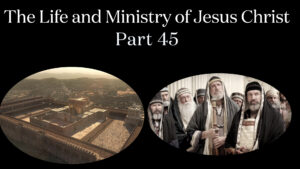
The Life and Ministry of Christ, Part 45
Passion Week – Tuesday
The dialogue with the Sadducees about the resurrection just finished without success and the Pharisees approached Jesus again with a question about the commandments. Remember they considered themselves to be the guardians and enforcers of the Law of Moses. So they came to Jesus asking His opinion about the great commandment, (Matthew 22:34-40; Mark 12:28-34).
Matthew 22:34–36 NKJV But when the Pharisees heard that He had silenced the Sadducees, they gathered together. Then one of them, a lawyer, asked Him a question, testing Him, and saying, “Teacher, which is the great commandment in the law?”
Mark tells us this lawyer was a scribe of the Pharisees. Since they considered themselves to be the custodians of the Law of Moses, they felt they had the right and duty to question Jesus. So they asked, “Which is the great commandment in the law?” Jesus answered them by quoting the Jewish confession of faith which is called the Shema. The Shema was the foundational expression of monotheism and the cornerstone of their faith, affirming their complete devotion to God. It is called the Shema because it begins with the Hebrew word “hear” – [shema]. The “Shema” is found in Deuteronomy 6:4-5.
Deuteronomy 6:4–5 NKJV “Hear, O Israel: The Lord our God, the Lord is one! You shall love the Lord your God with all your heart, with all your soul, and with all your strength.
If they obeyed these commands, God promised it would be well with them, they would go in and possess the good land. Their enemies would be cast out before them and their houses would be full of good things. The blessing for obeying this command is found in Deuteronomy 11:13-21. God promised to send rain in its seasons. He would bless their fields, harvests, and cattle. They would be able to eat and be satisfied.
Mark 12:29–30 NKJV Jesus answered him, “The first of all the commandments is: ‘Hear, O Israel, the Lord our God, the Lord is one. And you shall love the Lord your God with all your heart, with all your soul, with all your mind, and with all your strength.’ This is the first commandment.
Mark 12:31 NKJV And the second, like it, is this: ‘You shall love your neighbor as yourself.’ There is no other commandment greater than these.”
In Matthew 22:40, He said: “All of the Law and the Prophets depend on these two commandments.” Anyone who loves God and their neighbor, who is made in God’s image, would fulfill all the requirements of the Law and Prophets.
Mark 12:32–33 NKJV So the scribe said to Him, “Well said, Teacher. You have spoken the truth, for there is one God, and there is no other but He. And to love Him with all the heart, with all the understanding, with all the soul, and with all the strength, and to love one’s neighbor as oneself, is more than all the whole burnt offerings and sacrifices.”
The scribe said that to love God and one’s neighbor is more important than all of the offerings and sacrifices. He knew the value of love for God and for others. Since God looks on the heart, the public display of piety without inward personal holiness is useless. When the inward man is right with God, outward actions will please God.
Mark 12:34 NKJV Now when Jesus saw that he answered wisely, He said to him, “You are not far from the kingdom of God.” But after that no one dared question Him.
The scribe had the kind of spiritual understanding of God’s perspective and openness to what Jesus was saying that he was near to embracing God’s kingdom. He was near but not in. By saying “You are not far from the kingdom of God,” Jesus exhibited His true authority.
When the Pharisees dared not ask another question, Jesus asked them “Whose Son is the Christ?” (Matthew 22:41-46; Mark 12:35-37; Luke 20:41-44)
Matthew 22:41–42 NKJV While the Pharisees were gathered together, Jesus asked them, saying, “What do you think about the Christ? Whose Son is He?” They said to Him, “The Son of David.”
Jesus asked them about the lineage of the Christ. Why is the Christ regarded as the Son of David? How can Jesus Christ be both the Son of David and the Son of God? The term “Son of David” is a Messianic title that designates Jesus as the recipient of all of the promises God made to David concerning the future and eternal government. The title has historical and theological weight that is established in God’s covenant promise to David. Historically, the Son of David would establish the throne of David according to the promise. Theologically, God promised covenant love to David and his family and that his kingdom would endure forever. Isaiah saw the “son” who would rule on David’s throne who would be called Wonderful Counselor and Mighty God. He would establish it with justice and righteousness forever. The title Son of David bridges Jesus’ earthly ministry with His role as the eternal King of kings and Lord of lords.
Jeremiah 23:5–6 NKJV “Behold, the days are coming,” says the Lord, “That I will raise to David a Branch of righteousness; A King shall reign and prosper, And execute judgment and righteousness in the earth. In His days Judah will be saved, And Israel will dwell safely; Now this is His name by which He will be called: THE LORD OUR RIGHTEOUSNESS
Matthew 22:43–45 NKJV He said to them, “How then does David in the Spirit call Him ‘Lord,’ saying: ‘The Lord said to my Lord, “Sit at My right hand, Till I make Your enemies Your footstool” ’? If David then calls Him ‘Lord,’ how is He his Son?”
If the Messiah were simply from the lineage of David, an earthly son, why did David ascribe deity to Him? If they answered the question, they would have to admit to the virgin birth and accept Jesus as the Christ. If the Pharisees accepted Jesus as the Messiah, they could have entered into the Kingdom of God.
Matthew 22:46 NKJV And no one was able to answer Him a word, nor from that day on did anyone dare question Him anymore.
In Matthew 23, Jesus gave a strong warning to the multitudes and the leaders for rejecting Him, God’s Messiah.
Judgment on the Scribes and Pharisees – Matthew 23; Mark 12:38-40; Luke 20:45-57
Mark and Luke give a much shorter version of the Lord’s judgment on the scribes and Pharisees.
Luke 20:45–47 NKJV Then, in the hearing of all the people, He said to His disciples, “Beware of the scribes, who desire to go around in long robes, love greetings in the marketplaces, the best seats in the synagogues, and the best places at feasts, who devour widows’ houses, and for a pretense make long prayers. These will receive greater condemnation.”
Jesus was warning the scribes and Pharisees because they tried to look religious, but their actions are wrong. Their talk did not match their behavior.
Matthew 23:1–3 NKJV Then Jesus spoke to the multitudes and to His disciples, saying: “The scribes and the Pharisees sit in Moses’ seat. Therefore whatever they tell you to observe, that observe and do, but do not do according to their works; for they say, and do not do.”
Jesus wanted the multitudes to observe whatever the Pharisees told them, but not to do what they are doing. Their beliefs and practices aligned with general established doctrinal standards. The Pharisees were orthodox in teaching the people to pay attention to the Law and what Moses taught. Nothing was wrong with their exposition of the Law. but much was wrong with the way they lived.
Matthew 23:4 NKJV For they bind heavy burdens, hard to bear, and lay them on men’s shoulders; but they themselves will not move them with one of their fingers.
Matthew 23:5 NKJV But all their works they do to be seen by men. They make their phylacteries broad and enlarge the borders of their garments.
A phylactery is a small black leather cube or box that holds portions of scripture inside. The phylacteries containing Scripture were intended as a personal reminder of God’s words, but they had been transformed into a public display of spiritual devotion. Similarly, they had expanded the borders of their garments as a conspicuous display of their righteousness and devotion. This was done as an external Pharisaic display to gain human applause and recognition. True righteousness flows from the heart rather than by seeking recognition from others.
Deuteronomy 6:6-9 says, “These words which I command you today shall be in your heart. You shall teach them diligently to your children, and shall talk of them when you sit in your house, when you walk by the way, when you lie down, and when you rise up. You shall bind them as a sign on your hand, and they shall be as frontlets between your eyes. You shall write them on the doorposts of your house and on your gates.”
What good is the Law in a phylactery on your forehead or arm and enlarged borders of your garments if you do not do what God says? God wanted them to continually keep the words of the Law before them and allow them to be their guide, but they reduced spiritual commands to physical activities. They felt they were more spiritual if their phylactery was larger and the borders of their garments were long and trimmed with blue cords. These cords were intended to remind them that they were God’s special people. They overlooked the spiritual lesson and satisfied themselves with a larger phylactery and longer fringes.
Matthew 23:6–8 NKJV They love the best places at feasts, the best seats in the synagogues, greetings in the marketplaces, and to be called by men, ‘Rabbi, Rabbi.’ But you, do not be called ‘Rabbi’; for One is your Teacher, the Christ, and you are all brethren.
Matthew 23:9–10 NKJV Do not call anyone on earth your father; for One is your Father, He who is in heaven. And do not be called teachers; for One is your Teacher, the Christ.
Matthew 23:11–12 NKJV But he who is greatest among you shall be your servant. And whoever exalts himself will be humbled, and he who humbles himself will be exalted.
Jesus modeled the servant attitude by humbling Himself and becoming obedient unto death.
In Matthew 23:13-36, Jesus pronounced EIGHT WOES of condemnation on the scribes and Pharisees.
- They shut up the kingdom of heaven in people’s faces; for they refused to enter the kingdom of heaven and did not allow others to enter, (vs. 13).
- They made long prayers to impress people, but oppressed widows, whom they should have helped, (vs 14).
- They went to extreme efforts to make converts to their philosophy and then made their converts more wicked than they were, (vs. 15).
- Their reasoning was flawed. They said, “It means nothing to swear by God’s temple but it is binding to swear by the gold of the temple. Jesus asked, What is more important the gold or the Temple that makes the gold sacred?” (vss. 16-22) What is more important the gift or the altar that makes the gift sacred?
- They paid the full tithe from the tiniest income but ignored justice, mercy, and faith, (vss. 23-24).
- They maintained an outward religious morality demonstrating a particular status, but their hearts were filled with extortion and self-indulgence, (vss. 25-26). On the outside the cup and dish were clean, but inside it was filthy.
- They were like whitewashed tombs that were beautiful on the outside but filled with dead men’s bones. Their tried to hide their hypocrisy and lawlessness so that they appeared outwardly righteous to others, (vss. 27-28).
- They built tombs for the prophets and adorned monuments for the righteous and said they would not have killed the prophets, (vss. 29-30).
After pronouncing these woes, Jesus told the scribes and Pharisees what would happen to them.
Matthew 23:31–33 NKJV “Therefore you are witnesses against yourselves that you are sons of those who murdered the prophets. Fill up, then, the measure of your fathers’ guilt. Serpents, brood of vipers! How can you escape the condemnation of hell?
Matthew 23:34 NKJV Therefore, indeed, I send you prophets, wise men, and scribes: some of them you will kill and crucify, and some of them you will scourge in your synagogues and persecute from city to city,
Matthew 23:35–36 NKJV that on you may come all the righteous blood shed on the earth, from the blood of righteous Abel to the blood of Zechariah, son of Berechiah, whom you murdered between the temple and the altar. Assuredly, I say to you, all these things will come upon this generation.
Jesus was saying they filled up the measure of their father’s guilt. The scribes and Pharisees were responsible for all of the unjust deaths of righteous people. He mentioned Abel, the first righteous man in the Old Testament to be murdered, and Zechariah, son of Berechiah, one of the last prophets in the Old Testament who was stoned to death between the temple and the altar for denouncing the rulers’ sin. It is noteworthy that this chapter ends with Jesus’ grieving over Jerusalem.
Matthew 23:37–39 NKJV “O Jerusalem, Jerusalem, the one who kills the prophets and stones those who are sent to her! How often I wanted to gather your children together, as a hen gathers her chicks under her wings, but you were not willing! See! Your house is left to you desolate; for I say to you, you shall see Me no more till you say, ‘Blessed is He who comes in the name of the Lord!’ ”
The Lord did not take pleasure in pronouncing these woes over His people. He was deeply grieved that despite God’s extensive efforts in sending His prophets and His Son, they were met with disdain, rejection, and death. After speaking these words to the crowds, Pharisee, and scribes, He left the Temple grounds and went to the Mount of Olives.
- What are the two great commandments and how do they relate?
- What was wrong with the religion of the Pharisees? Is it wrong to wear your righteousness as a symbol for others to see?
- Why did Jesus place judgment on the Pharisees and scribes?