
The Life and Ministry of Christ, Part 28
When Jesus arrived in Jerusalem, there was much debate and controversy over Him. About the middle of the feast, Jesus went into the temple and taught. The Pharisees and the chief priests sent officers to take Him, but He walked out and no one was able to lay a hand on Him.
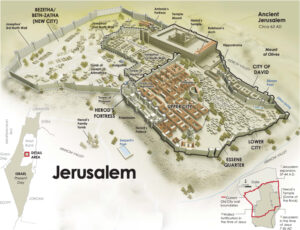
After the Feast of Tabernacles, Jesus went to the Mount of Olives, where He spent the night in the garden. On the eastern side of the Kidron valley is a ridge known as the Mount of Olives. It is parallel to Jerusalem’s old city and the Temple Mount and rises 300 feet above it. The eastern portions of the Kidron valley and the Mount of Olives have been used for thousands of years as burial grounds and are believed to be the largest Jewish cemetery in the world. They believe that the resurrection will begin at the Kidron valley and the Mount of Olives. Solomon built high places for Chemosh and Molech on the Mount of Olives. Jesus went to the Mount of Olives many times to pray. In John 8:1, Jesus went to the Mount of Olives.
John 8:2 NKJV Now early in the morning He came again into the temple, and all the people came to Him; and He sat down and taught them.
The scribes and Pharisees were still furious about Jesus and were attempting to discredit Him.
John 8:3-4 NKJV Then the scribes and Pharisees brought to Him a woman caught in adultery. And when they had set her in the midst, they said to Him, “Teacher, this woman was caught in adultery, in the very act.”
Looking for another opportunity to accuse Him, they found a woman caught in adultery, but Jesus refused to enter into a debate about her guilt. They told Jesus the Law said that she should be taken out and stoned, however, they omitted the part of the Law that said both the man and woman should be put to death, (Leviticus 20:10; Deuteronomy 22:22-24). They knew that if He said, “Let her go free” they could accuse Him of opposing the Law. If He condemned her, He would be an enemy of the Roman government for not being merciful. As they continued pressing Him, Jesus stooped down and began writing on the ground with His finger.
John 8:7 NKJV So when they continued asking Him, He raised Himself up and said to them, “He who is without sin among you, let him throw a stone at her first.”
This verse is often used to excuse sin. Jesus did not justify her sin but condemned those who were guilty but have not been exposed. Those convicted by their conscience, walked away one by one.
John 8:10 NKJV When Jesus had raised Himself up and saw no one but the woman, He said to her, “Woman, where are those accusers of yours? Has no one condemned you?”
Jesus did not address the woman’s guilt, but those who condemned her.
John 8:11 NKJV She said, “No one, Lord.” And Jesus said to her, “Neither do I condemn you; go and sin no more.”
After showing her mercy, Jesus told her to sin no more or live a life of purity in the future.
“I AM” the Light of the World – John 8:12-59
Before the story of the woman taken in adultery, Jesus spoke about giving “living water.”
John 8:12 NKJV Then Jesus spoke to them again, saying, “I am the light of the world. He who follows Me shall not walk in darkness, but have the light of life.”
John includes many of Jesus’ “I AM” statements.
The “I AM” statements relate to His being the Son of God.
- John 6:35 – “I am the Bread of life.”
- John 8:12 – “I am the Light of the world.”
- John 10:7, 9 – “I am the Door.”
- John 11:25 – “I am the resurrection and the life.”
- John 14:6 – “I am the way, and the truth, and the life.”
- John 15:1 – “I am the True Vine.”
- John 18:6, 8 – In the garden, Jesus said: “I AM He.”
Look closer at this word, “I am the Light of the World.
John 8:12 NKJV “I am the light of the world. He who follows Me shall not walk in darkness, but have the light of life.”
Throughout the Old Testament, the Israelites recognized that the LORD was their “light and salvation,” (Psalms 27:1). From the time God led them to the promised land and protected them, the glory of God’s presence was their light, (Exodus 13:21-22; 14:19-25). They knew that the LORD was their light and would be the light for His people in the end of the age, (Isaiah 60:19-22; Revelation 21:23-24). While the Jewish religious leaders were agitated with Him, Jesus tells them, “I am the light of the world.” The word “light” contrasts with the darkness that is prevalent in the world.
John 8:13 NKJV The Pharisees therefore said to Him, “You bear witness of Yourself; Your witness is not true.”
Read John 8:14-18 and ask: Why is Jesus’ witness true?
John 8:14 NKJV Jesus answered and said to them, “Even if I bear witness of Myself, My witness is true, for I know where I came from and where I am going; but you do not know where I come from and where I am going.”
Jesus’ self-testimony is valid because He possesses knowledge of His origin and destination. Not knowing where He came from and where He was going prevented His critics from understanding His claim to be the Light of the world. Jesus was operating from a level of knowledge and authority that was beyond earthly judgment. No earthly witness is capable of validating His claims because of His divine origin. He is able to speak with an authority that the religious leaders did not have. Jesus’ testimony is exempt from their scrutiny because He is the Son of God.
John 8:15–16 NKJV You judge according to the flesh; I judge no one. And yet if I do judge, My judgment is true; for I am not alone, but I am with the Father who sent Me.
John 8:17–18 NKJV It is also written in your law that the testimony of two men is true. I am One who bears witness of Myself, and the Father who sent Me bears witness of Me.”
The heavenly Father gave testimony of Jesus openly at His baptism and later at the mount of transfiguration when He said, “This is My beloved Son in Whom I am well pleased.” (Matthew 3:17, Mark 9:7).
John 8:19 NKJV Then they said to Him, “Where is Your Father?” Jesus answered, “You know neither Me nor My Father. If you had known Me, you would have known My Father also.”
The Pharisees were confused about whether He was referring to God or an earthly parent. This was a fundamental problem with their understanding of Christ’s identity. By questioning Him, they admitted their ignorance of Jesus’ true identity.
John 8:20 NKJV These words Jesus spoke in the treasury, as He taught in the temple; and no one laid hands on Him, for His hour had not yet come.
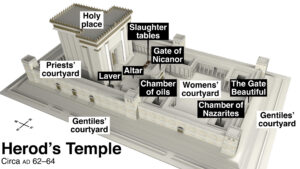
In Herod’s temple, the “treasury” was a name given to the “court of the women.” According to the Mishnah (Middot 2:5) the Women’s Court contained the treasury. The Mishnah is the first written collection of the Jewish oral traditions. Along the colonnade that ran around the court and against the wall were 13 trumpet-shaped boxes for the contributions of worshippers. Nine were for receipt of what was legally required of worshipers and four were for voluntary gifts. Jesus sat opposite the treasury watching people put money in when the widow gave two copper mites. Women were not allowed further into the Temple. Jesus was in the treasury and they could not lay their hands on Him to take Him.
John 8:21–22 NKJV Then Jesus said to them again, “I am going away, and you will seek Me, and will die in your sin. Where I go you cannot come.” So the Jews said, “Will He kill Himself, because He says, ‘Where I go you cannot come’?”
Why were these words so important to His audience? Why would they “die in their sin?” They would die in their sin because they rejected the Savior. Apart from Him there is no way to obtain forgiveness of sins or enter into heaven.
John 8:23-24 NKJV And He said to them, “You are from beneath; I am from above. You are of this world; I am not of this world. Therefore I said to you that you will die in your sins; for if you do not believe that I am He, you will die in your sins.”
“I am He” refers to the deity of the Lord Jesus.
John 8:25 NKJV Then they said to Him, “Who are You?” And Jesus said to them, “Just what I have been saying to you from the beginning.”
Christ had made this clear to them in many ways. They could not understand and know who He was due to their prejudice, stubborn hearts, and unbelief.
John 8:26–27 NKJV I have many things to say and to judge concerning you, but He who sent Me is true; and I speak to the world those things which I heard from Him.”They did not understand that He spoke to them of the Father.
John 8:28–29 NKJV Then Jesus said to them, “When you lift up the Son of Man, then you will know that I am He, and that I do nothing of Myself; but as My Father taught Me, I speak these things. And He who sent Me is with Me. The Father has not left Me alone, for I always do those things that please Him.”
John 8:30 NKJV As He spoke these words, many believed in Him.
“When you lift up the Son of Man” refers to Christ’s crucifixion.
John 3:14-15 NKJV And as Moses lifted up the serpent in the wilderness, even so must the Son of Man be lifted up, that whoever believes in Him should not perish but have eternal life.
John 12:32 NKJV And I, if I am lifted up from the earth, will draw all peoples to Myself.
True Freedom – John 8:31-59
Many of them believed in Him and in response to their belief, Jesus gave this test of true discipleship.
John 8:31–32 NKJV Then Jesus said to those Jews who believed Him, “If you abide in My word, you are My disciples indeed. And you shall know the truth, and the truth shall make you free.”
We know what that means, but they did not understand it and did not know they were in bondage to sin.
John 8:33 NKJV They answered Him, “We are Abraham’s descendants, and have never been in bondage to anyone. How can You say, ‘You will be made free’?”
Israel had been in bondage to Egypt, Assyria, Babylon, Persia, Greece, and now to Rome. They thought they were ‘free’ since they had a religious heritage. While they were speaking to Jesus, they were in bondage to sin and Satan.
John 8:34–36 NKJV Jesus answered them, “Most assuredly, I say to you, whoever commits sin is a slave of sin. And a slave does not abide in the house forever, but a son abides forever. Therefore if the Son makes you free, you shall be free indeed.
What does it mean to be a slave of sin?
Romans 6:16 NKJV Do you not know that to whom you present yourselves slaves to obey, you are that one’s slaves whom you obey, whether of sin leading to death, or of obedience leading to righteousness?
John 8:37-38 NKJV “I know that you are Abraham’s descendants, but you seek to kill Me, because My word has no place in you. I speak what I have seen with My Father, and you do what you have seen with your father.”
Their “father” that Jesus was referring to was Satan.
John 8:39 NKJV They answered and said to Him, “Abraham is our father.”
They said that because they felt that Jesus had insulted them.
John 8:39–41 NKJV Jesus said to them, “If you were Abraham’s children, you would do the works of Abraham. But now you seek to kill Me, a Man who has told you the truth which I heard from God. Abraham did not do this. You do the deeds of your father.” Then they said to Him, “We were not born of fornication; we have one Father—God.”
They were saying they had never committed spiritual adultery and had always been true to God.
John 8:42–43 NKJV Jesus said to them, “If God were your Father, you would love Me, for I proceeded forth and came from God; nor have I come of Myself, but He sent Me. Why do you not understand My speech? Because you are not able to listen to My word.”
John 8:44 NKJV “You are of your father the devil, and the desires of your father you want to do. He was a murderer from the beginning, and does not stand in the truth, because there is no truth in him. When he speaks a lie, he speaks from his own resources, for he is a liar and the father of it.”
John 8:45–47 NKJV “But because I tell the truth, you do not believe Me. Which of you convicts Me of sin? And if I tell the truth, why do you not believe Me? He who is of God hears God’s words; therefore you do not hear, because you are not of God.”
Jesus was speaking like this to them because they revealed their relation to the devil by their desires and the way they lived.
John 8:48–49 NKJV Then the Jews answered and said to Him, “Do we not say rightly that You are a Samaritan and have a demon?” Jesus answered, “I do not have a demon; but I honor My Father, and you dishonor Me.”
These are two of the worst things they could say. By saying He was a Samaritan, they meant that He was not a pure Jew.
John 8:50-52 NKJV “And I do not seek My own glory; there is One who seeks and judges. Most assuredly, I say to you, if anyone keeps My word he shall never see death.”
What Jesus said to them would be made clear after His crucifixion and resurrection. “He shall never see death,” refers to the second death or eternity in the lake of fire.
John 8:53 NKJV Are You greater than our father Abraham, who is dead? And the prophets are dead. Who do You make Yourself out to be?”
John 8:54–55 NKJV Jesus answered, “If I honor Myself, My honor is nothing. It is My Father who honors Me, of whom you say that He is your God. Yet you have not known Him, but I know Him. And if I say, ‘I do not know Him,’ I shall be a liar like you; but I do know Him and keep His word.
John 8:56–58 NKJV Your father Abraham rejoiced to see My day, and he saw it and was glad.” Then the Jews said to Him, “You are not yet fifty years old, and have You seen Abraham?” Jesus said to them, “Most assuredly, I say to you, before Abraham was, I AM.
The “I AM” reference refers back to Exodus 3:14.
Exodus 3:14 NKJV And God said to Moses, “I AM WHO I AM.” And He said, “Thus you shall say to the children of Israel, ‘I AM has sent me to you.’ ”
John 8:59 NKJV Then they took up stones to throw at Him; but Jesus hid Himself and went out of the temple, going through the midst of them, and so passed by.
Why does religious heritage not bring salvation?
Who is Jesus? How can we know for sure?