
The Life and Ministry of Christ, Part 42
Passion Week
Sunday – The Triumphal Entry – Matthew 21:1-11; Mark 11:1-11; Luke 19:29-44; John 12:12-19
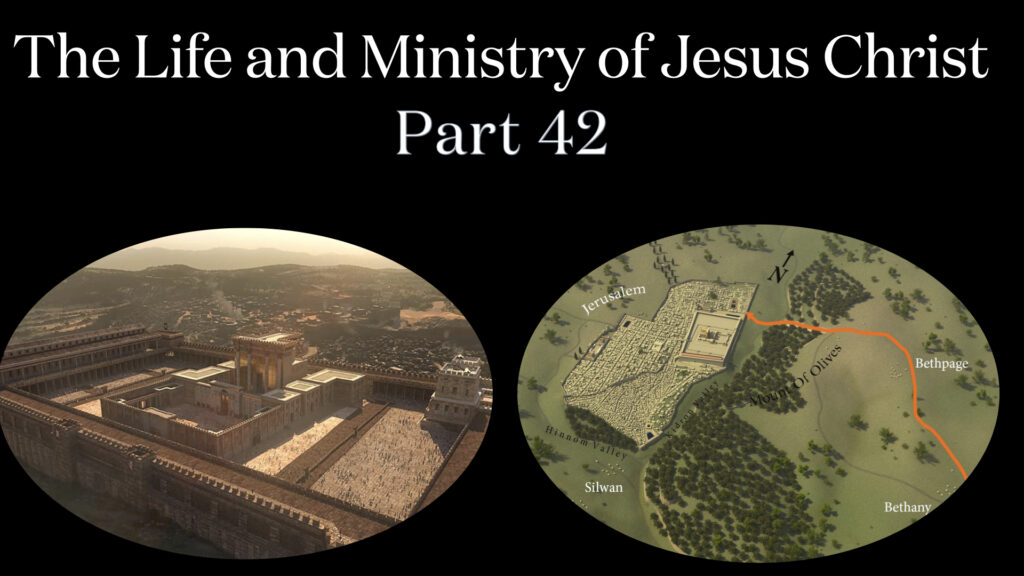
The Lord’s last journey into Jerusalem started at the celebration meal in Bethany at Simon the leper’s house. After Mary anointed Jesus with the costly oil of spikenard and the celebration of the events of His ministry to those present, Jesus went to Jerusalem. The four Gospels give significant attention to the closing events of Jesus’ earthly ministry. On Sunday, Jesus went from Bethany up to Bethphage and descended the Mount of Olives into Jerusalem.
Passion Week
Sunday — April 9
Matthew 21:1; Mark 11:1; Luke 19:29; John 12:12
- Jesus’ triumphant entrance into Jerusalem
- Spends the night in Bethany
Monday — April 10
Matthew 21:12; Mark 11:22; Luke 19:45
- Leaves Bethany
- Curses the fig tree on the way into the city
- Weeps over Jerusalem
- He goes into the temple and cleanses it for the second time in His ministry
- Late in day, He leaves the city and spends the night in Bethany
Tuesday — April 11
Matthew 21:20; Mark 11:20; Luke 20:36; John 12:20
- Leaves Bethany
- Finds the fig tree withered; teaches on faith
- Possesses the temple and its precincts; confounds and pronounces woes upon His enemies
- Leaves city; Olivet Discourse on way back to Bethany
- Judas bargains with Sanhedrin to betray Jesus
- Spends the night in Bethany
Wednesday — April 12
- No record in the Gospels, but much activity as Jesus prepares for Last Supper and as Judas and Sanhedrin prepare for Jesus’ arrest
- Remains in Bethany throughout the day, stays night there
Thursday — April 13
Matthew 26:1; Mark 14:1; Luke 22:1
- Peter and John sent to make preparation for Passover meal
- After sunset, eats meal with the twelve; washes disciples feet
- Lord’s Supper instituted
- Judas departs
- To Garden of Gethsemane; Jesus’ agony
- Betrayal by Judas; arrest by Sanhedrin
- To house of High Priest as Sanhedrin is convened; Peter betrays Jesus
Friday — April 14
Matthew 26:1; Mark 14:53; Luke 22:54; John 18:12-14
The Trials of Jesus Christ
First trial, before Annas during the night time hours. Annas was looking for an accusation, biding time until the Sanhedrin could be gathered at High Priests’ villa. Annas was a powerful High Priest and the father-in-law of Caiaphas who was High Priest that year.
Second [and primary] trial before Sanhedrin, Jesus was condemned, misused
Third trial, took place immediately at dawn. At this time Peter denied Jesus a third time and the LORD looks upon him. The condemnation was repeated and Jesus was taken to the Romans.
Fourth trial before Pilate
Fifth trial before Herod. Herod asks for a miracle.
Sixth trial before Pilate
-
- Jesus was scourged; the city cried out, “Crucify Him or we will tell Rome!”
- Jesus was turned over to be crucified
- Jesus mocked by Roman soldiers in the praetorium and a crown of thorns was put on His head
- Judas hung himself and Jesus bears His cross to gate on north of city and is crucified around nine in the morning.
Jesus’ Seven Sayings from the Cross
- “Father, forgive them…”
- “Today…with me in paradise”
- “Woman, behold your son…” [darkness from noon – three in the afternoon]
- “My God, My God…”
- “I thirst”
- “It is finished”
- “Into Your hands…”
The Death of the God-Man
About 3 in the afternoon, the veil was torn, rocks rent; some graves opened and people were raised to mortality and go into the city
- Jesus’ side pierced
- Passover lambs slain in temple
- Jesus buried by sundown
Saturday — April 15
Matthew 27:66
- At the request of the Jewish leadership, Pilate grants a guard and sets a seal on the tomb of Jesus
Sunday — April 16
Matthew 28:1; Mark 16:1; Luke 24:1; John 20:1
Jesus Christ rises from the dead (before dawn) and makes five appearances on the day of His rising:
- To Mary Magdalene [given a message to the disciples]
- To the other women who come to the tomb [intending to complete the burial preparation of His body]
- To two disciples on the Road to Emmaus
- To Simon Peter [nowhere recorded, but alluded to in Luke 24:33 and 1 Corinthians 1:5]
- To the astonished disciples [Thomas is absent]
Matthew 21:1–2 NKJV Now when they drew near Jerusalem, and came to Bethphage, at the Mount of Olives, then Jesus sent two disciples, saying to them, “Go into the village opposite you, and immediately you will find a donkey tied, and a colt with her. Loose them and bring them to Me.
Two theories are offered to explain this event.
- The Lord knew the owner from a previous encounter, and he offered Jesus assistance.
- This event demonstrated the omniscience and authority of the Lord. Everything happened just as it was predicted.
Everything about the event demonstrated God’s foreknowledge and divine power.
Matthew 21:3–5 NKJV And if anyone says anything to you, you shall say, ‘The Lord has need of them,’ and immediately he will send them.” All this was done that it might be fulfilled which was spoken by the prophet, saying: “Tell the daughter of Zion, ‘Behold, your King is coming to you, Lowly, and sitting on a donkey, A colt, the foal of a donkey.’ ”
Zechariah 9:9 NKJV “Rejoice greatly, O daughter of Zion! Shout, O daughter of Jerusalem! Behold, your King is coming to you; He is just and having salvation, Lowly and riding on a donkey, A colt, the foal of a donkey.”
This was a prophecy that helped definitively point to Jesus Christ the Messiah. In fulfillment to the prophecy, the King of kings and Lord of lords was coming into Jerusalem.
Matthew 21:6–7 NKJV So the disciples went and did as Jesus commanded them. They brought the donkey and the colt, laid their clothes on them, and set Him on them.
Matthew 21:8 NKJV And a very great multitude spread their clothes on the road; others cut down branches from the trees and spread them on the road.
Matthew 21:9 NKJV Then the multitudes who went before and those who followed cried out, saying: “Hosanna to the Son of David! ‘Blessed is He who comes in the name of the Lord!’ Hosanna in the highest!”
Matthew 21:10-11 ESV And when he entered Jerusalem, the whole city was stirred up, saying, “Who is this?” And the crowds said, “This is the prophet Jesus, from Nazareth of Galilee.”
By entering into Jerusalem in this manner, Jesus deliberately revealed Himself to be the Messiah. The phrases “Son of David” and “Blessed is He who comes in the name of the Lord” clearly identified Him as the Messiah. He was coming into Jerusalem with the authority of Jehovah to do His will. Prior to this event, Jesus avoided this kind of display but now this event manifests the purpose for His coming.
Hebrews 10:5–7 NKJV Therefore, when He came into the world, He said: “Sacrifice and offering You did not desire, But a body You have prepared for Me. In burnt offerings and sacrifices for sin You had no pleasure.Then I said, ‘Behold, I have come— In the volume of the book it is written of Me— To do Your will, O God.’ ”
The next verse of Zechariah’s prophecy shows why the multitudes responded the way they did.
Zechariah 9:10 NKJV I will cut off the chariot from Ephraim And the horse from Jerusalem; The battle bow shall be cut off. He shall speak peace to the nations; His dominion shall be ‘from sea to sea, And from the River to the ends of the earth.’
The multitudes thought that Jesus of Nazareth was coming into Jerusalem to set up His throne. They were expecting what John was shown on the Isle of Patmos.
Revelation 19:11–12 NKJV Now I saw heaven opened, and behold, a white horse. And He who sat on him was called Faithful and True, and in righteousness He judges and makes war. His eyes were like a flame of fire, and on His head were many crowns. He had a name written that no one knew except Himself.
Revelation 19:13–14 NKJV He was clothed with a robe dipped in blood, and His name is called The Word of God. And the armies in heaven, clothed in fine linen, white and clean, followed Him on white horses.
Revelation 19:15–16 NKJV Now out of His mouth goes a sharp sword, that with it He should strike the nations. And He Himself will rule them with a rod of iron. He Himself treads the winepress of the fierceness and wrath of Almighty God. And He has on His robe and on His thigh a name written: KING OF KINGS AND LORD OF LORDS.
Everyone had missed the prophecy of the suffering Savior Who would redeem people from their sins. Jesus told His disciples what was going to happen when He went back to Jerusalem.
Matthew 20:18–19 NKJV “Behold, we are going up to Jerusalem, and the Son of Man will be betrayed to the chief priests and to the scribes; and they will condemn Him to death, and deliver Him to the Gentiles to mock and to scourge and to crucify. And the third day He will rise again.”
Watch carefully Jesus’ actions as He entered into Jerusalem and into the temple.
Mark 11:11 NKJV And Jesus went into Jerusalem and into the temple. So when He had looked around at all things, as the hour was already late, He went out to Bethany with the twelve.
Malachi 3:1 says, “The Lord, whom you seek, will suddenly come to His temple.”
Monday – three events happened.
- Jesus cursed the fig tree – Matthew 21:18-20; Mark 11:12-14, 20, 21.
The story of the fig tree is covered on two days. It started Monday morning on the way to Jerusalem.
Mark 11:12–13 NKJV Now the next day, when they had come out from Bethany, He was hungry. And seeing from afar a fig tree having leaves, He went to see if perhaps He would find something on it. When He came to it, He found nothing but leaves, for it was not the season for figs.
Mark 11:14 NKJV In response Jesus said to it, “Let no one eat fruit from you ever again.” And His disciples heard it.
It is noteworthy that the fig tree looked good from a distance, but it was not the season for figs. Since Jesus was always teaching His disciples, there must be something more to what He was saying and doing. Jesus had been ministering to Abraham’s descendants for three years and had seen no change in them.
Hosea 9:10 says, “I saw your fathers as the firstfruits on the fig tree in its first season.”
In Luke 13:6-9, Jesus gave a parable of the fig tree that had no fruit. In the parable, Jesus said the owner of the vineyard said, “For three years I have come seeking fruit on this fig tree and find none. Cut it down.” The keeper of the vineyard said, “Let it alone this year also, until I dig around it and fertilize it. If it bears fruit, well. But if not, cut it down.” The cursing of the unfruitful fig tree was a prophecy on Israel. Jesus was saying that God expects fruit from His people. After cursing the fig tree, Jesus went into Jerusalem to the Temple.
- Cleansing of the Temple – Matthew 21:12-13; Mark 11:15-17; Luke 19:45-46
Mark 11:15 NKJV So they came to Jerusalem. Then Jesus went into the temple and began to drive out those who bought and sold in the temple, and overturned the tables of the money changers and the seats of those who sold doves.
Mark 11:16–17 NKJV And He would not allow anyone to carry wares through the temple. Then He taught, saying to them, “Is it not written, ‘My house shall be called a house of prayer for all nations’? But you have made it a ‘den of thieves.’ ”
Mark 11:18–19 NKJV And the scribes and chief priests heard it and sought how they might destroy Him; for they feared Him, because all the people were astonished at His teaching. When evening had come, He went out of the city.
The cleansing of the Temple demonstrated the Lord’s sovereign control over the House of God. Over the process of years, the Temple courts had become a religious market place where fraudulent transactions occurred. A doctrine of accommodation had been adopted. The priests had defiled the Temple by making what was holy profane and common. The Temple was supposed to be the holy house of God where people would come to find the presence of God. They had made it a market of commerce and den of thieves. Vendors were selling animals and goods for sacrifices. The tables of money changers was another item of convenience for worshippers. Upon cleansing the Temple, Matthew tells us that Jesus healed the blind and the lame.
- Healing in the Temple – Matthew 21:14
Matthew 21:14 NKJV Then the blind and the lame came to Him in the temple, and He healed them.
This was another demonstration of the purpose for the Lord’s coming.
Luke 4:18–19 NKJV “The Spirit of the Lord is upon Me, Because He has anointed Me To preach the gospel to the poor; He has sent Me to heal the brokenhearted, To proclaim liberty to the captives And recovery of sight to the blind, To set at liberty those who are oppressed; To proclaim the acceptable year of the Lord.”
Matthew 21:15 NKJV But when the chief priests and scribes saw the wonderful things that He did, and the children crying out in the temple and saying, “Hosanna to the Son of David!” they were indignant
Matthew 21:16–17 NKJV and said to Him, “Do You hear what these are saying?” And Jesus said to them, “Yes. Have you never read, ‘Out of the mouth of babes and nursing infants You have perfected praise’?” Then He left them and went out of the city to Bethany, and He lodged there.
From the Temple, Jesus went to Bethany and spent the night.